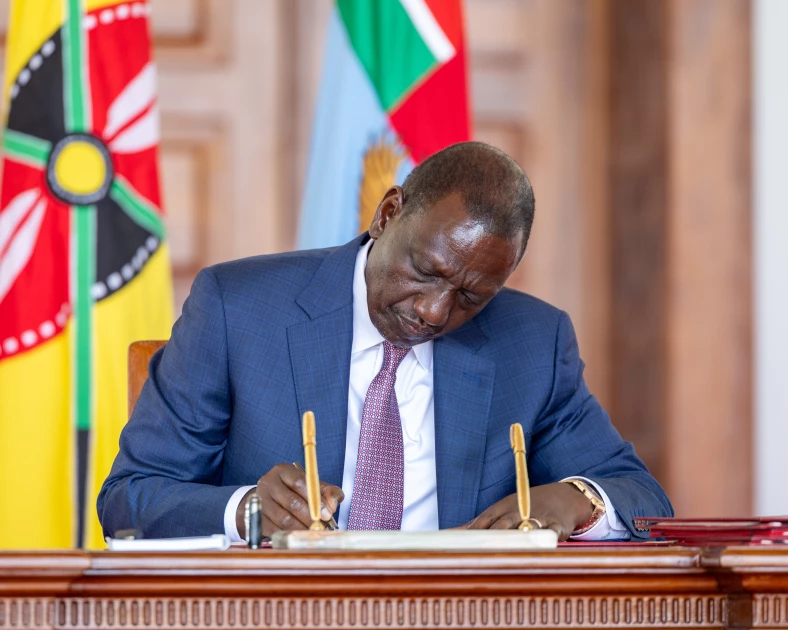
President William Ruto has appointed 15 judges to the Court of Appeal in a move aimed at strengthening Kenya’s appellate judiciary.
The appointments, made under Article 166(1)(b) of the Constitution, were published in a special issue of the Kenya Gazette dated January 27, 2026.
The newly appointed judges include his lawyer Katwa Kigen, IPOA boss Issack Hassan and Chacha Mwita, among others.
The appointments were formally announced through Gazette Notice No. 1000 in the Special Issue of The Kenya Gazette, published by authority of the Republic of Kenya.
In the notice, President Ruto stated: “In exercise of the powers conferred by Article 166 (1) (b) of the Constitution, I, William Samoei Ruto, President of the Republic of Kenya and Commander-in-Chief of the Defence Forces, appoint… to be Judges of the Court of Appeal.”
Those appointed to the appellate bench are Hedwig Imbosa Ong’udi, Mathews Nduma Nderi, Linnet Mumo Ndolo, Enock Chacha Mwita, Lucy Mwihaki Njuguna, Samson Odhiambo Okongo, Rachel Chepkoech Ngetich, Ahmed Issack Hassan, Paul Lilan, Joseph Kipchumba Kigen Karwa, Stephen Andersen Radido Okiyo, Brown Murungi Kairaria, Munyao Sila, Johnson Okoth Okello and Byram Ongaya.
The publication of the appointments in the Kenya Gazette has given them full legal force, clearing the way for the judges to formally assume office at one of Kenya’s superior courts.
The Court of Appeal is Kenya’s second-highest court and plays a critical role in determining appeals from the High Court and other superior courts.
The appointment of additional judges is expected to enhance the court’s capacity from 27 to 42 judges to handle its growing caseload and reduce the backlog of appeals.
The appointments stem from a recruitment exercise conducted by the Judicial Service Commission (JSC), which on January 22 announced the nomination of the fifteen candidates.
At the time, the Commission indicated that the recruitment was intended to strengthen the court’s capacity and accelerate the disposal of pending appeals.
Chief Justice Martha Koome said the JSC had completed a thorough and transparent selection process and would forward the successful candidates’ names to the President in line with constitutional requirements. She noted that the process adhered strictly to the law and the principles governing judicial appointments.
According to the JSC, the vacancies were advertised publicly, and the recruitment involved multiple stages of public participation. These included shortlisting and interviews that were conducted openly and broadcast live to enhance transparency and accountability.
The Commission further stated that all candidates were vetted in accordance with the Constitution, the Judicial Service Act, and relevant regulations. In making its selections, the JSC applied constitutional values such as merit, integrity, fairness, gender equity, inclusivity, and regional balance.
Candidates were assessed on a range of criteria, including professional competence, experience, integrity, communication skills, sound judgment, and demonstrated commitment to the rule of law and public service.































Comments
Sign in with Google to comment, reply, and like comments.
Continue with Google